 Loading...


The Philippines remains one of Southeast Asia’s most compelling markets. Political risks for businesses operating in the country are oftentimes an accumulation of regulatory, reputational, and institutional friction that businesses must learn to read early.
The Philippines rewards businesses that understand it.
A young, dynamic workforce, a rapidly growing consumer class, and a strategic position at the heart of ASEAN make it one of Southeast Asia’s most compelling markets for both local and foreign capital. The World Bank continues to describe the Philippines as one of the more dynamic economies in East Asia and the Pacific.
But in 2026, it is also a market shaped by real political turbulence, and companies that ignore that reality are leaving themselves dangerously exposed.
The Philippines is not an easy market to read from a spreadsheet. Formal rules matter, but so do political timing, administrative discretion, public sentiment, and the relationships among institutions that make and enforce policy. A company may be legally compliant and still find itself exposed because the political environment around its issue has changed. Impeachment proceedings, shifting governance alliances, corruption controversies, and a regulatory enforcement environment that moves quickly, sometimes without warning, have created serious policy and regulatory risk for businesses across sectors.
Whether you are a foreign investor conducting due diligence, a multinational managing operations on the ground, or a local business navigating government relations, understanding and actively managing political risk in the Philippines is no longer optional.
It is a strategic imperative.
Did You Know?
The Philippines scores 69 out of 100 on the 2026 Political Risk Index, placing it in a medium-to-high risk band for investors. (World Population Review, 2026)
Net FDI into the Philippines fell 17% to about USD 7.8 Billion in 2025, its lowest level since 2015 (excluding pandemic years). (BSP / MB.com.ph, 2026)
The Philippines ranked 120th out of 182 countries in Transparency International’s 2025 Corruption Perceptions Index, with a score of 32 out of 100. (Transparency International / Daily Tribune, 2026)
The 2026 Economic Crime and Geopolitics Index classifies the Philippines as being at “high risk” for political instability, with its risk score rising from 71.65 in late 2025 to 72.6. (South Asia Foresight Network / BusinessWorld, 2026)
What Political Risk Actually Means in the Philippines
Political risk is the probability that political decisions, public controversies, or institutional conditions will significantly affect a business’s ability to operate, invest, protect its reputation, or remain profitable.
In the Philippine context, that definition takes on a very concrete and immediate shape.
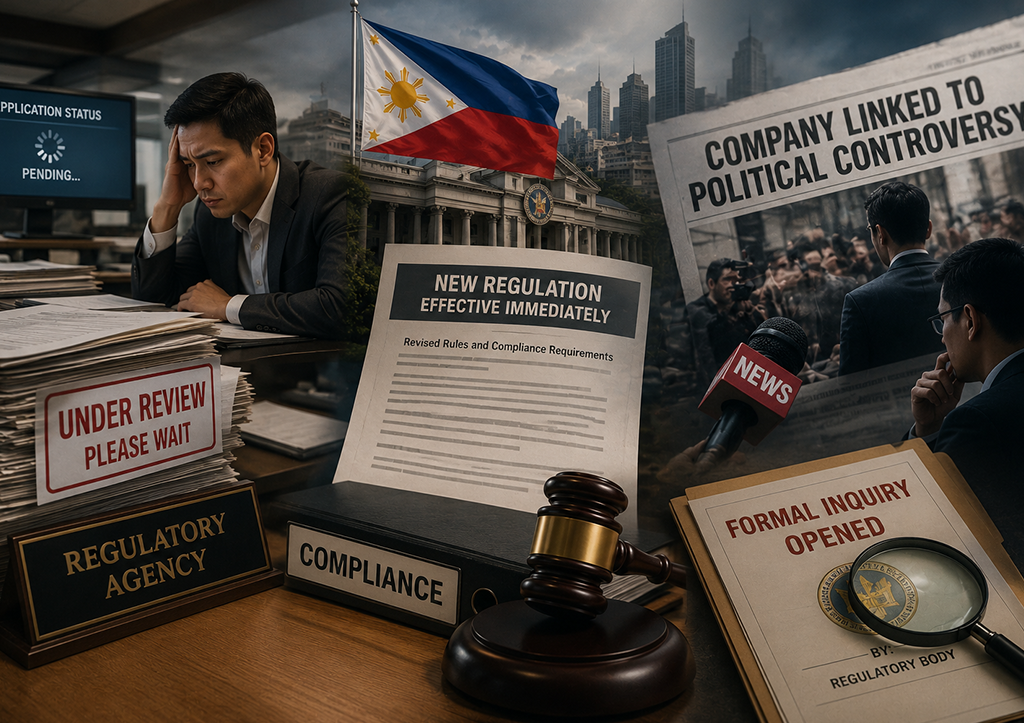
It looks like a licensing application that inexplicably stalls at an agency that was once cooperative.
It appears as a regulatory issuance that rewrites the rules of an entire industry with little public consultation and even less notice.
It emerges as a media narrative linking a company to a political controversy and prompting a regulator to open a formal inquiry days later.
These are not hypothetical scenarios. They are the current operating reality for businesses across the Philippines.
The 2026 Political Landscape: A Candid Briefing
BMI, a Fitch Solutions unit, has flagged elevated political risk in the Philippines in 2026, citing impeachment proceedings, political fragmentation, and wider governance concerns that are collectively weighing on business confidence.
The BSP’s Business Confidence Index turned pessimistic in March 2026, falling from 8.2% in February to -24.3%, largely due to geopolitical tensions and rising fuel costs. (BSP Business Expectations Survey Report, March 2026)
According to the DBM, public infrastructure spending fell by 45.6% in April 2026 in comparison to last year’s data, reflecting slower implementation in response to the flood control scandal.
Foreign direct investment also contracted sharply before a partial recovery driven by green energy inflows.
These indicators have multiple causes and should not be attributed to politics alone. Taken together, however, they show why companies cannot treat political, regulatory, reputational, and operational risks as separate concerns. The risks are specific and manageable, provided leadership knows where to look and how to respond.
Four Warning Signs That Political Risk Is Already in Your Business
Political risk rarely announces itself. It arrives through patterns.
Here are the early warning indicators every business in the Philippines should be monitoring:
Unexplained licensing delays.
Permit applications that once moved smoothly begin to stall, or additional requirements are suddenly being asked without a clear technical reason. Regulators do not always communicate political pressure through formal channels.
Abrupt rule changes with no consultation.
Sudden administrative orders that upend established frameworks, especially in highly regulated sectors like media, energy, telecoms, healthcare and financial services, signal that political dynamics are reshaping enforcement.
Negative media-regulator narratives.
When a company begins appearing in politically charged coverage that also involves regulators, these matters should be taken seriously. There are some instances when a technical compliance issue is reframed as an issue involving consumer protection, national security, or even corruption; when something like this happens, the audience and stakes have already changed. These narratives have a documented history of triggering regulatory action regardless of compliance status, and can quickly lead to hearings or formal inquiries.
Shifting enforcement patterns.
A regulator that was previously hands-off begins issuing repeated information requests, expanding audits, or applying an old rule with new intensity. This may reflect a change in leadership, policy direction, public pressure, or inter-agency priorities, even when the company’s compliance profile has not materially changed.

The Five-Step Political Risk Management Protocol
Managing political risk is not about predicting the future with certainty. It is about building the institutional capacity to detect change coming early, interpret it correctly, and make coordinated decisions before a manageable issue turns into a full-blown crisis.
1. Political Risk Assessment
Map your operations, including, licensing dependencies, regulatory relationships and public-facing activities, among others, against the current political landscape. Identify which agencies and political dynamics have direct bearing on the business, with the intention of rating these potential disruptions by probability, impact and velocity of escalation. Do not limit the assessment to mere legal compliance.
2. Stakeholder Mapping
Effective stakeholder mapping for government relations in the Philippines charts both formal and informal influence networks, and should not merely be a contact list. Who does the agency head listen to? Which legislators have oversight interest in your sector? Map formal mandates and informal influence across regulators, legislators, local officials, industry groups and credible public voices. These relationships give the business the intelligence to engage proactively before pressure arrives.
3. Scenario Planning
Model at least three futures: a baseline, an adverse disruption scenario, and an opportunity scenario. Define the trigger events for each and pre-develop response protocols. Assign decisions, response owners, evidence requirements, and escalation thresholds in advance. The companies that navigate Philippine policy transitions well are almost always the ones that planned for them in advance.
4. Early-Warning Monitoring
A regulatory early-warning system combines political intelligence, legislative and regulatory monitoring, media tracking, and direct government engagement. In the Philippines, the line between media, politics, and regulatory action is thin and fast-moving. Intelligence from legal, communications, government affairs, and operations must be assessed together, not in sequence.
5. Proactive Policy Engagement
The most effective risk mitigation is proactive, not defensive. Build the company’s credibility and voice with key stakeholders before you need them: through policy consultations, industry coalitions, and strategic media engagement. The objective is not special treatment: it is to ensure that policymakers understand the operational consequences of proposed measures and can distinguish legitimate concerns from unsupported narratives. In many cases, disciplined, low-key engagement is more effective than public confrontation. Businesses that are known and respected in the policy conversation are demonstrably less vulnerable to arbitrary regulatory action.
Building Your Political Risk Strategy
Political risk in the Philippines in 2026 is real and rising, but it is manageable. But the goal is to approach political risk with the right strategic infrastructure.
The gap between business needs and political realities can be bridged through deep engagement with the Philippine policy landscape. This means reading the political environment clearly, engaging intelligently, and positioning the organization to come out ahead when others are still scrambling to understand what happened.
Businesses that survive political and regulatory transitions, and even use them to gain competitive advantage, share common traits: they invest in relationships before crises arise, they monitor the environment systematically, and they plan for multiple scenarios rather than hoping for the best.
If your business is operating in the Philippines and you do not yet have a clear political risk strategy for 2026, the time to build one is now, not after the first licensing delay lands on your desk, and not after the media narrative has already gotten ahead of you.
In this political environment, the companies that thrive are not the ones who wait to see what happens. They are the ones that are informed, credible, and prepared. They may not know exactly what will happen, but they know what to watch out for, what it means, and what to do next.

Atty. Keila H. Garcia
Senior Manager, Government Affairs
Keila has been a public policy professional since 2016, with extensive experience as a lawyer with the Office of the President in Malacanang. She has deep experience in regulatory and legislative advocacy working in multinational companies such as Lazada. Further, she also worked as a Consultant for the United Nations Environment Programme.
Keila holds a BA degree in Sociology from the University of the Philippines, a Juris Doctor from the UP College of Law, and a Master in Public Policy from the National University of Singapore (NUS). She is a 2020 Dean’s Leadership Awardee from the Lee Kwan Yew School of Public Policy (NUS).